
Is the UK Property Market Really Dead? What the 2026 Numbers Mean for Landlords
Is the UK Property Market Really Dead? What the 2026 Numbers Mean for Landlords
Property headlines suggest a struggling market, but the latest figures tell a more complicated story. For landlords and property investors, understanding the difference could be more valuable than following the headlines.
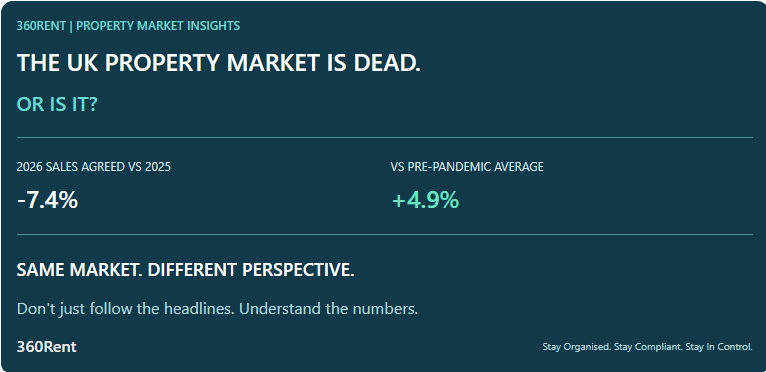
The UK property market is dead.
Buyers have disappeared.
Sellers are struggling.
Nobody wants to move.
We've all seen headlines like these.
And with mortgage costs, economic uncertainty and changing market conditions, it's understandable why confidence has weakened.
But there's an important difference between a market that's struggling and a market that's stopped working.
The latest property statistics suggest the UK market is far from dead. It's simply becoming more demanding.
And for landlords, that distinction matters.
What do the latest UK property figures actually show?
Chris Watkin's UK Property Market Stats Show for Week 39 of 2026 examined listings, sales agreed, withdrawals, price reductions and rental activity.
The figures reveal a market that remains active, although it's operating differently from previous years.
Here are some of the key numbers.
Market indicator
2026 position
New property listings, year to date
1.406 million
Homes sold subject to contract, year to date
944,000
Net sales, year to date
728,000
Properties for sale, 1 October
764,000
Average advertised rent, September
£1,777 pcm
Available rental properties, 1 October
299,000
Source: Chris Watkin's UK Property Market Stats Show, Week 39, published 9 October 2026. The figures are based on the show's market dataset and definitions.
These numbers don't describe a market where nothing is happening.
They describe a market where buyers, sellers, landlords and tenants are still active.
But activity alone doesn't tell us whether conditions are improving.
For that, we need context.
Property sales are down but not historically weak
According to the report, approximately 944,000 homes had been sold subject to contract so far in 2026.
That's 7.4% below the comparable period in 2025.
Not particularly encouraging at first glance.
But compare the same figure with earlier years.
Sales agreed were:
- 10.9% higher than the comparable period in 2023.
- 4.9% above the 2017–2019 pre-pandemic average.
- Just 1.2% below the previous decade's year-to-date average.
Suddenly, the picture becomes more balanced.
The market is slower than last year, but that doesn't mean it's stopped functioning.
And that's an important lesson for anyone making property decisions.
The year you choose for comparison can dramatically change the story.
Buyers have more choice and sellers need to respond
One of the most interesting figures is the number of homes available for sale.
There were approximately 764,000 properties on the market at the beginning of October 2026.
That's higher than the equivalent figure in October 2025 and substantially higher than October 2023.
More choice changes how buyers behave.
When fewer properties are available, buyers may feel pressure to move quickly.
When more properties compete for attention, buyers can afford to be more selective.
That doesn't mean nobody is buying.
It means sellers may need to work harder to demonstrate value.
And that brings us to pricing.
Is overpricing becoming a bigger problem than demand?
The report suggests that asking-price reductions remain common.
During August, 11.1% of properties for sale had their asking prices reduced.
Across 2026 so far, the average monthly proportion was 12.8%, compared with a longer-term six-year average of 10.9%.
That suggests more properties are requiring price adjustments than usual.
There's also an interesting difference between the average asking price of all newly listed homes and the average asking price of homes achieving a sale.
But this is important:
Those are different groups of properties.
The difference cannot automatically be interpreted as the discount individual sellers are accepting.
Nevertheless, the wider lesson is clear.
Putting a property on the market is one thing.
Pricing it appropriately for the available demand is another.
A good property at an unrealistic price can struggle.
A reasonably priced property in a suitable location may still attract strong interest.
The market doesn't have to be booming for a well-considered property decision to work.
What about the rental market?
This is where the figures become particularly interesting for landlords.
The report gives the following average advertised rents:
Period
Average monthly advertised rent
September 2021
£1,390
September 2025
£1,791
September 2026
£1,777
The September 2026 figure was slightly below September 2025.
But it remained substantially above the figure recorded five years earlier.
Meanwhile, the report identified approximately 299,000 properties available to rent at the beginning of October, compared with 295,000 in September 2025.
These figures indicate that rental market conditions are changing too.
However, advertised rents aren't the same as rents actually paid by all existing tenants, and a national average can conceal substantial regional differences.
A landlord in Yorkshire may face very different conditions from one in London.
The important question isn't simply:
"Are rents rising nationally?"
It's:
"What is happening to demand, affordability and rental values where my property is located?"
Higher rents don't automatically mean higher profits
This is another distinction landlords should understand.
A property achieving £1,500 per month in rent might look attractive.
But what happens after:
Mortgage payments?
Maintenance?
Insurance?
Compliance costs?
Management fees?
Void periods?
Tax?
A landlord's actual financial position depends on considerably more than the advertised rent.
And when borrowing costs rise, the difference becomes even more important.
Revenue is not profit.
That's why landlords need to look beyond headline rents and yields.
The numbers behind each individual property matter.
A changing market rewards preparation
When property markets are particularly strong, it's possible for poor processes to go unnoticed.
Properties may let quickly.
Buyers may compete aggressively.
Price growth can make investment decisions appear more successful than they really are.
When conditions become more challenging, weaknesses become more visible.
A property that's overpriced may sit empty.
An unexpected repair may significantly affect cash flow.
A missed compliance deadline can create unnecessary risk.
An unplanned void can quickly reduce the year's return.
None of these issues necessarily means property is a bad investment.
But they do demonstrate why good management matters.
A changing market doesn't automatically require landlords to work harder. It requires them to work more intelligently.
The difference between following the market and managing your property
National statistics are useful.
They provide perspective.
They help identify trends.
They challenge exaggerated headlines.
But they can't tell you everything about your own portfolio.
Consider two landlords.
Both read that property transactions are down.
Both hear that borrowing costs have increased.
Both see that rental asking prices are relatively stable.
Landlord A reacts to the headlines.
Landlord B looks at their own position.
What rent is coming in?
What costs are increasing?
Which properties have repairs outstanding?
Are there compliance expenses approaching?
When might a tenancy change?
Is there enough financial resilience to manage an unexpected void?
Landlord B isn't necessarily going to make a better investment decision every time.
But they're working with more relevant information.
The market tells you what's happening around your business. Your property records tell you what's happening inside it.
Professional landlords need better systems
This is something we're increasingly focused on at 360Rent.
Independent landlords shouldn't need complicated corporate software to manage their properties professionally.
But they should have access to tools that help them understand what's happening.
Important documents organised.
Compliance dates tracked.
Repairs recorded.
Tenancy information accessible.
Reminders before deadlines.
Property information available when needed.
These systems don't predict interest rates.
They don't guarantee investment returns.
And they can't prevent every problem.
But they can reduce unnecessary administration and make important information easier to access.
That's valuable whether the market is booming, slowing or moving sideways.
Don't confuse a difficult market with a dead one
The latest figures don't suggest the UK property market has disappeared.
Properties are still being listed.
Sales are still being agreed.
People are still moving.
Rental properties are still entering the market.
But the environment is more demanding in several respects.
Buyers have more choice.
Pricing matters.
Borrowing costs affect affordability.
And landlords need to pay close attention to their individual property finances.
The lesson isn't that everyone should rush out and buy another property.
Nor is it that everyone should sell.
It's that good property decisions require good information.
And good property management requires good systems.
The market isn't dead. But relying on guesswork is becoming increasingly expensive.
Know the market.
Understand your numbers.
Organise your properties.
And make decisions based on information rather than fear.
Stay Organised. Stay Compliant. Stay In Control.
This article provides general information rather than financial or investment advice. The statistics quoted come from the UK Property Market Stats Show and may use different methodologies from official government statistics. Local market conditions vary significantly.
Related Articles
- Estate Agents Feel the Heat as the UK Property Market Cools... But the Work Doesn't Stop
- Property Auctions Are Growing: What Does This Mean for Landlords?
- Why Are Estate and Letting Agencies Expanding While Others Are Leaving the Market?
- DIY Landlords in 2026: If Letting Agents Need Higher Standards, Should Landlords Raise Theirs Too?
- How Much Do Letting Agents Really Cost? (UK Breakdown for 2026)