
Rental Yields Reach 7.9%... But Growing a Property Portfolio Creates a Different Challenge
There's an interesting story developing in buy-to-let.
Despite higher borrowing costs, regulatory change and years of headlines suggesting landlords are leaving the market, new figures suggest experienced landlords are still finding opportunities.
Fleet Mortgages' latest Rental Barometer puts the average rental yield across England and Wales at 7.9% in Q3 2026, up from 7.5% a year earlier.
Yorkshire & Humberside topped its regional table at 9.3%, closely followed by the North East at 9.2%. Fleet Mortgages
But there's another statistic in the report that I find even more interesting.
The average portfolio among Fleet's landlord borrowers has increased to:
18 properties.
That's up from 16 in the previous quarter.
And just 12 properties a year ago. Fleet Mortgages
That raises an important question.
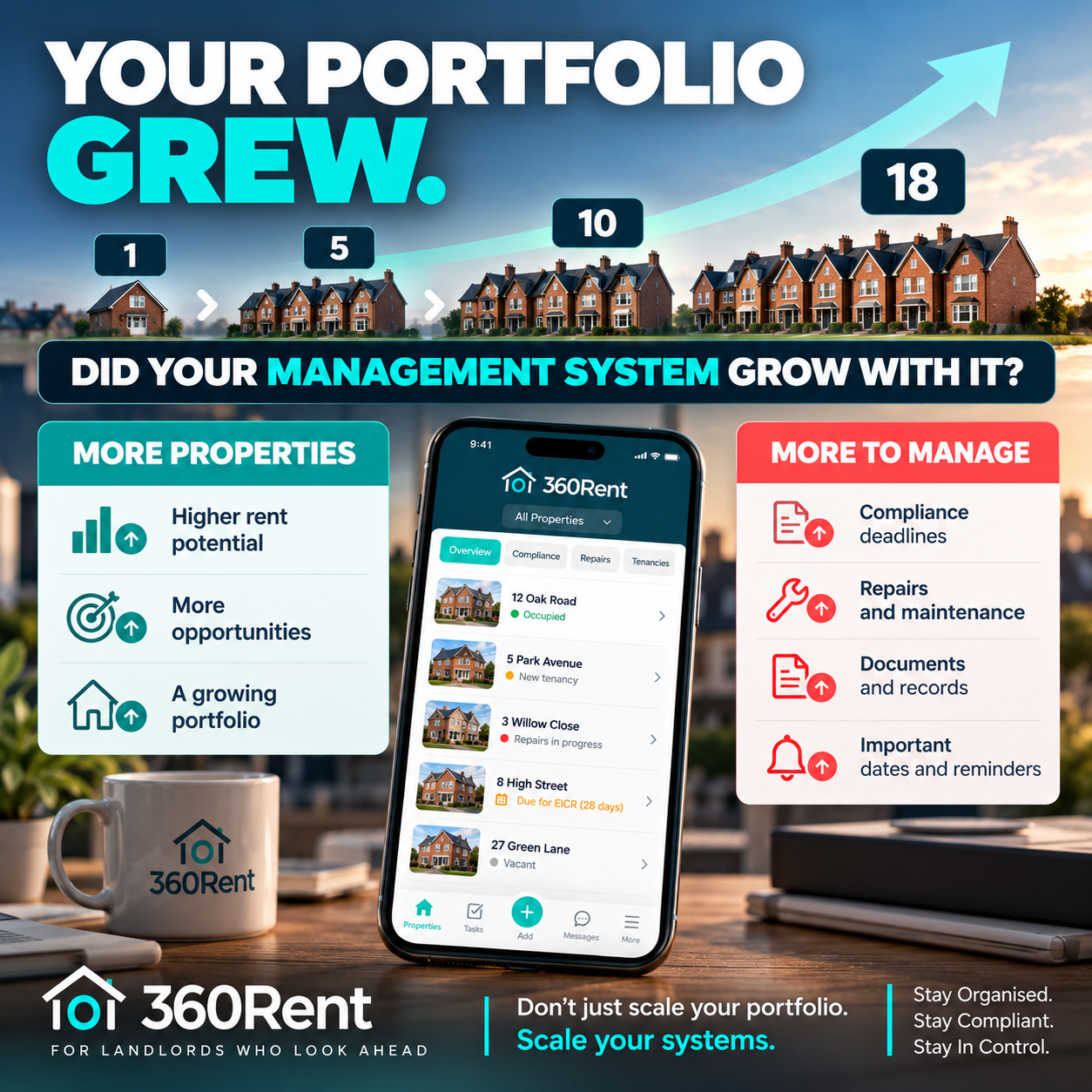
As a landlord's portfolio grows, can the way they manage it grow too?
The regional yield picture is changing
First, the numbers.
Fleet's Q3 data shows considerable differences between regions:
Region
Q3 2026 average yield
Yorkshire & Humberside - 9.3%
North East - 9.2%
East Midlands - 8.4%
North West - 8.3%
West Midlands - 8.2%
Wales - 7.5%
South East - 7.2%
South West - 7.1%
East Anglia - 7.0%
Greater London - 6.4%
These are Fleet's figures from its own buy-to-let lending data, so they shouldn't be treated as guaranteed yields for every property in those regions.
But the regional differences are interesting. Fleet Mortgages
A postcode doesn't make a good investment on its own.
Neither does a headline yield.
Purchase price, achievable rent, mortgage costs, maintenance, voids, tax, management, compliance costs and local tenant demand all matter.
A 9% gross yield isn't the same thing as a 9% return in your pocket.
Bigger landlords appear to be taking a larger share
The portfolio data tells another story.
Landlords owning 15 or more properties accounted for 30% of Fleet's Q3 applications, up from 23% a year earlier.
Landlords with at least four properties represented 66% of applications.
Meanwhile, applications from landlords owning between one and three properties fell from 29% to 24% quarter-on-quarter. Fleet Mortgages
Again, we need some perspective.
This doesn't mean the average UK landlord suddenly owns 18 properties.
These are Fleet Mortgages' borrowers and applicants, in a specialist buy-to-let lending context.
But it does suggest something worth watching.
Experienced and portfolio landlords are continuing to participate in the market… And some are expanding when the numbers make sense.
But higher yields don't necessarily mean bigger profits
This is an important distinction.
Average yields increased… But so did financing pressure.
Fleet reports that average rental cover at mortgage origination fell from 144% to 132% during the quarter.
It also reports increases in average market fixed mortgage rates during Q3. Fleet Mortgages
That's why looking at yield in isolation can be misleading.
Imagine two properties.
Property A generates an 8% gross yield but carries expensive borrowing, frequent maintenance and substantial management costs.
Property B generates 7% but has cheaper finance, lower maintenance and stronger net cash flow.
Which is the better investment?
You can't answer that from the headline yield.
The number that matters is what remains after the costs.
And there's another cost: your time
This becomes increasingly important as a portfolio grows.
One property might mean:
- One tenancy.
- One Gas Safety Certificate.
- One EICR.
- One set of documents.
- A handful of repairs.
- A few contractors.
- A few important dates.
Now multiply that by five.
Then ten.
Then eighteen.
Suddenly you're potentially dealing with dozens of certificates, tenancy records, repair histories, documents, contractors and deadlines.
And unlike your mortgage payment, there's another cost that doesn't always appear neatly on a spreadsheet:
Your time.
That's where growth can expose weak systems.
What works for one property may not work for ten
A landlord with one property might comfortably manage things using:
- A calendar.
- A spreadsheet.
- An email folder
- WhatsApp.
- Documents on a laptop.
- And memory.
There's nothing inherently wrong with that… The problem comes when the portfolio grows.
Property 1 has its Gas Safety Certificate due.
Property 3 has an EICR approaching.
Property 5 has an outstanding repair.
Property 7 has documents sitting in an email.
Property 9 has a contractor waiting for approval.
Property 12 has a tenancy issue.
Property 18...
You get the idea… The portfolio has grown… But the management system hasn't.
Growth creates complexity
This applies far beyond property.A small business can often survive on memory and informal processes. As it grows, those same processes become weaknesses.
Property portfolios are no different.
More properties create more:
- Documents.
- Dates.
- Repairs.
- People.
- Communication.
- Decisions.
- Compliance responsibilities.
And opportunities for something to be overlooked.
The answer isn't necessarily hiring someone to handle everything.
And it isn't spending every evening doing administration either… It's building systems that can grow with you.
This is where professional landlords think differently
The most interesting thing about Fleet's figures isn't necessarily that larger landlords own more property.
It's that running a larger portfolio forces you to think differently.
You stop asking:
"Can I remember when that's due?"
And start asking:
"What system tells me when it's due?"
You stop asking:
"Where did I save that certificate?"
And start asking:
"Where do all my property records live?"
You stop rebuilding the history of a repair from WhatsApp messages.
You create a record as you go.
That's professionalisation… Not wearing a suit… Not having an office…
Building repeatable systems.
The portfolio test
Here's a useful question for any landlord thinking about buying their next property:
If your portfolio doubled tomorrow, would your current way of managing it still work?
If you own one property, imagine two.
If you own three, imagine six.
If you own five, imagine ten.
Could you still quickly see:
- Which certificates are approaching expiry?
- Which repairs remain outstanding?
- Where every important document is?
- What's happening with each tenancy?
- What needs your attention this week?
If the answer is no, the problem isn't necessarily your portfolio… It's the infrastructure underneath it.
This is where 360Rent fits
360Rent is being built around exactly this idea.
A landlord shouldn't need to rebuild their management process every time they add another property.
Each property should have somewhere for its important information.
- Documents.
- Tenancy information.
- Compliance dates.
- Repairs.
- Reminders.
- History.
The objective isn't to make landlords spend more time managing property.
It's the opposite… As the portfolio grows, the system should absorb more of the organisation.
That gives landlords the freedom to concentrate on the things software can't do for them:
Making decisions.
- Assessing investments.
- Talking to tenants.
- Choosing contractors.
- Planning what happens next.
Don't just scale your portfolio. Scale your systems.
The latest figures provide some encouraging signs for buy-to-let.
Average yields across Fleet's lending areas are higher than a year ago.
Some regional yields remain particularly strong.
Experienced landlords continue to participate.
And new landlords are still entering the market. Fleet Mortgages
But growing from one property to ten isn't simply ten times the rent.
It's also ten times the potential administration.
The landlords who grow successfully will increasingly need to think like business owners.
Understand the numbers.
Understand the risks.
Build repeatable processes.
Use professionals where they're valuable.
Use technology where it removes unnecessary administration.
And make sure the management system grows alongside the portfolio.
Because acquiring the next property is only half the challenge.
You still have to manage it.
Don't just grow your portfolio…. Build a system capable of growing with it.
Stay Organised. Stay Compliant. Stay In Control.