The AI Race Is Taking Off in Property. But What About Independent Landlords?
Estate agents are investing in AI, automation and smarter technology. Could the next wave of property innovation put the same tools into the hands of independent landlords?
The property industry is entering an interesting period.
Estate agencies are increasingly investing in artificial intelligence, automated communication and technology designed to make their businesses more efficient.
And some aren't simply buying existing software.
They're building their own.
Recent developments involving Moveli and The Property Franchise Group suggest that technology is becoming an increasingly important part of how estate agencies plan to operate.
But while much of the attention is on estate agents, there's another group worth considering.
What about the landlords who manage their own properties?
If estate agencies can automate repetitive tasks, streamline communication and reduce administration, why shouldn't independent landlords benefit from similar technology?
And perhaps more importantly:
What if landlords could help decide which tools get built next?
Estate agencies are investing in their own technology
Moveli has launched an AI-powered marketing appraisal and proposal tool within its internally developed Moveli OS platform.
The technology helps brokers prepare personalised property proposals using information such as:
- Comparable properties currently for sale
- Recently sold properties
- Automated valuation data
- Local market information
- Interactive maps
Rather than sending a conventional PDF, brokers can create interactive webpages that work across phones, tablets and computers.
The system can also track when a seller opens or revisits a proposal, providing information that may help brokers decide when to follow up.
It's an example of technology becoming part of the everyday workflow rather than operating as a separate tool.
And Moveli intends to develop further automation and AI functionality.
Larger agency groups are investing too
The Property Franchise Group has also announced an investment in Enteka Ai, a conversational AI platform already being used across more than 210 offices within its network.
The technology can handle enquiries through:
- Telephone
- SMS
- Live chat
It can also qualify enquiries and arrange appointments.
These developments suggest property businesses are looking beyond traditional customer relationship management software.
They're exploring how automation can manage routine work while people concentrate on tasks that require experience, judgement and personal interaction.
And that raises an interesting question.
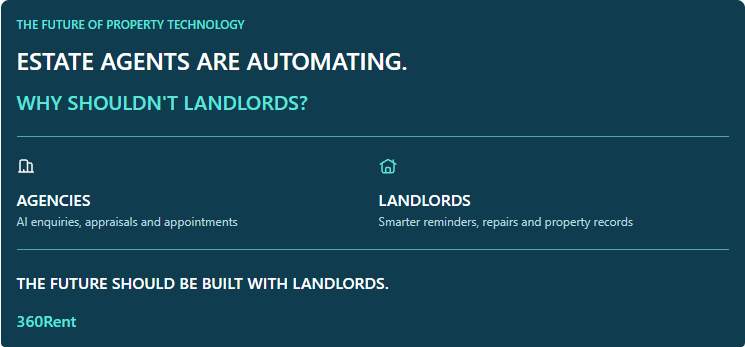
If automation is becoming valuable enough for major agency businesses to invest in, could it become just as valuable for landlords?
Landlords have an administration problem too
Consider a landlord managing five properties.
They might have five sets of compliance documents.
Multiple tenants.
Several contractors.
Different renewal and expiry dates.
Repairs at different stages.
Emails, messages, invoices and photographs spread across different places.
None of these tasks is necessarily difficult in isolation.
The problem is keeping everything organised while managing the rest of your life.
And for many independent landlords, property management isn't their only occupation.
They have jobs.
Businesses.
Families.
Other responsibilities.
Rental property should generate an income. It shouldn't automatically become a second job.
Yet much of the work involved in managing property remains surprisingly manual.
That's where automation could make a meaningful difference.
What could an automated landlord system actually do?
Imagine a property-management platform that doesn't simply store information.
It helps landlords act on it.
1. Compliance reminders that work in the background
A landlord enters the expiry date of a Gas Safety Certificate, EICR or another important document.
Instead of relying on memory, the system tracks the date and provides reminders in advance.
The landlord remains responsible for arranging the appropriate checks.
But the system reduces the risk of forgetting.
2. Repairs that move through a clear process
A tenant reports a repair.
The issue is recorded against the property.
The landlord reviews it and decides what happens next.
A contractor can be contacted.
Progress is tracked.
Photographs, notes and completion details are recorded.
Future automation could help remind the landlord when a repair is awaiting an update.
The system doesn't decide whether a repair is safe or appropriate.
It helps make sure the information doesn't disappear into a conversation.
3. Property information available when it's needed
Imagine asking:
"When does the Gas Safety Certificate expire at Property 3?"
Or:
"Which repairs are still outstanding?"
Or:
"Where's the invoice for the boiler repair last February?"
A future AI-assisted system could potentially retrieve that information from the landlord's own organised records.
That's a practical application of AI.
Not generating unnecessary content.
Finding the right information when it's needed.
4. Less repetitive communication
Many landlord communications follow predictable patterns.
Acknowledging a repair report.
Confirming an appointment.
Reminding somebody that information is outstanding.
Following up with a contractor.
Preparing a routine update.
Technology could help prepare or automate appropriate communications, with the landlord retaining control over what is sent.
5. A clearer picture across the portfolio
A landlord with ten properties shouldn't have to open ten separate spreadsheets to understand what needs attention.
A useful system could bring together:
Upcoming compliance dates.
Outstanding repairs.
Important tenancy information.
Documents requiring attention.
Tasks awaiting action.
And eventually, more advanced portfolio insights.
The goal isn't more technology. It's less unnecessary work.
But does every landlord actually want AI?
That's something the technology industry should be asking more often.
Not every problem needs artificial intelligence.
Sometimes a simple automated reminder is the best solution.
Sometimes a well-organised document system is more useful than a chatbot.
Sometimes the most valuable feature is a repair history that takes seconds to find.
The mistake would be building complicated AI features simply because AI is fashionable.
The right question isn't: “Where can we add AI?”
It's:
“What do landlords spend time doing that they shouldn't have to do manually?”
Then find the simplest, most reliable solution.
That might be automation.
It might be AI.
Or it might simply be better software design.
Professional management shouldn't be reserved for large agencies
There's another important point.
Large property businesses can invest significant sums into developing technology.
They have specialist teams, established processes and substantial budgets.
Independent landlords generally don't.
But a landlord with two properties still needs to keep records, manage repairs and understand their responsibilities.
A landlord with five properties still needs systems.
And a landlord with fifteen properties may face much of the same administrative complexity as a small letting agency.
Professional property management shouldn't depend on having a large office or an expensive software budget.
Technology has the potential to make good management systems more accessible.
That's an opportunity worth exploring.
What if landlords helped build the technology themselves?
This is where I think the conversation becomes particularly interesting.
For years, property technology has largely been developed around the needs of estate agencies, letting agencies and larger property businesses.
That's understandable.
They're established commercial customers.
But independent landlords have their own requirements.
And those requirements aren't always the same.
A landlord managing three properties doesn't necessarily need an enterprise-level CRM.
They might need something much simpler.
Something that helps them:
Stay organised.
Understand what's happening.
Avoid unnecessary administration.
Keep records.
And remain in control.
What if the people actually managing those properties helped shape the tools being developed?
That's the direction we're exploring with 360Rent
360Rent is being built around independent landlords who want to manage their properties professionally without automatically outsourcing everything.
The foundation is straightforward:
Property information.
Tenancies.
Compliance dates.
Documents.
Repairs.
Reminders.
One place to keep the important things organised.
But the longer-term opportunity is bigger.
As automation and AI become more accessible, we want landlords to help identify where they would genuinely make a difference.
Not features developed because they sound impressive.
Features developed because they solve real problems.
Perhaps it's automatic contractor follow-ups.
Perhaps it's easier document retrieval.
Perhaps it's a smarter way to identify outstanding tasks.
Perhaps it's something we haven't considered yet.
That's why building a community around 360Rent matters.
Landlords shouldn't simply be customers waiting for the next software update.
They should have a voice in what comes next.
Technology should give landlords more control, not less
There's a sensible caution here.
Property management involves people's homes, personal information, money and legal responsibilities.
AI can make mistakes.
Automation can fail.
And not every decision should be delegated to software.
A responsible landlord platform should be designed around appropriate safeguards, privacy, transparency and human oversight.
The landlord should remain accountable for decisions that require judgement.
Technology should support those decisions, not quietly make them without permission.
The objective isn't an AI landlord.
It's a better-equipped human landlord.
The next property technology revolution shouldn't leave landlords behind
Moveli's latest development and TPFG's investment in conversational AI show how seriously parts of the agency sector are taking automation.
And I think that's encouraging.
Innovation should challenge established processes.
It should make businesses more efficient.
It should create better experiences.
But it shouldn't stop at the estate agency office.
Independent landlords deserve access to tools that make managing property simpler too.
And perhaps the most exciting opportunity isn't simply giving landlords more software.
It's allowing them to help build the software they actually need.
So here's the question:
If you could automate one part of managing your rental property tomorrow, what would it be?
Chasing contractors?
Tracking compliance dates?
Finding documents?
Managing repairs?
Tenant communication?
Or something completely different?
We're interested in the answers.
Because the future of landlord technology shouldn't just be built for landlords.
It should be built with them.
360Rent — Stay Organised. Stay Compliant. Stay In Control.
Note: The AI developments described are based on the companies' reported announcements. The potential 360Rent features discussed are ideas for future development, not claims that these capabilities are currently available.
Related Articles
- Best Software for Landlords in the UK
- Do Landlords Really Need Letting Agents? (An Honest 2026 Guide)
- Why am I Loosing so much time looking for Compliance Documents?
- Your Property Doesn't Need Managing. Your Information Does.
- The Best Organisational Tools for UK Landlords in 2026: How to Save Time, Stay Compliant and Reduce Stress