Your Property Doesn't Work 9–5: Why Landlords Need Systems That Don't Switch Off
A tenant notices a leak at 7:30pm.
You suddenly remember a certificate needs renewing while you're sitting on the sofa.
A contractor calls while you're at work.
You need to check a tenancy detail on a Sunday afternoon.
Property doesn't operate to office hours.
And increasingly, neither do the people interacting with it.
Recent research covering more than 3,000 UK property business telephone numbers found that 94.1% of calls to sales and letting agencies between 6pm and 9pm on weekdays went unanswered.
Separate research cited alongside the study suggests that as many as 32% of property leads can arrive outside conventional working hours, depending on how those hours are defined.
For estate agents, that presents an obvious commercial challenge.
But there's an equally important lesson here for landlords.
What happens to your property management when you're not actively thinking about it?
Landlords have an out-of-hours problem too
Most independent landlords aren't sitting behind a property-management desk from 9am until 5pm.
They have jobs.
Businesses.
Families.
Holidays.
Weekends.
And lives outside property.
For many people, being a landlord is something managed around everything else.
That's perfectly reasonable.
The problem comes when the system behind the property depends entirely on the landlord remembering everything.
Your Gas Safety Certificate doesn't care that you're busy.
Your EICR doesn't know you're on holiday.
A repair doesn't wait because it's Sunday.
An important tenancy date doesn't move because you've had a difficult week.
The responsibility remains even when your attention is somewhere else.
The answer isn't being available 24/7
This distinction matters.
Better property management shouldn't mean landlords becoming permanently available.
Quite the opposite.
Technology should reduce how much information landlords need to carry around in their heads.
There's a big difference between:
Being available 24/7
and
Having a system working in the background 24/7.
The second is where technology becomes genuinely useful.
If you have to remember it, there's a chance you'll forget it
Think about how many dates can eventually become attached to a rental property.
Certificates.
Inspections.
Tenancy information.
Repairs.
Contractor visits.
Documents.
Renewals.
Reminders.
Now multiply that across several properties.
Nobody deliberately forgets something important.
Things get missed because human beings are busy.
That's why we use calendars.
It's why businesses use CRMs.
It's why banks send payment notifications.
And it's why modern cars tell us when they need servicing rather than expecting us to remember when we last changed the oil.
Good systems reduce our reliance on memory.
Property management should be no different.
From reactive landlord to organised landlord
A lot of traditional property management is reactive.
Something happens.
You deal with it.
Something expires.
You renew it.
A tenant contacts you.
You find the relevant information.
A contractor asks what happened last time.
You search through your messages.
It works.
But there's another way of approaching it.
Instead of waiting for something to demand your attention, your property-management system can help tell you what needs attention next.
That's a subtle difference, but an important one.
You're moving from:
"What have I forgotten?"
to:
"What's coming up?"
That's control.
Reminders aren't just notifications
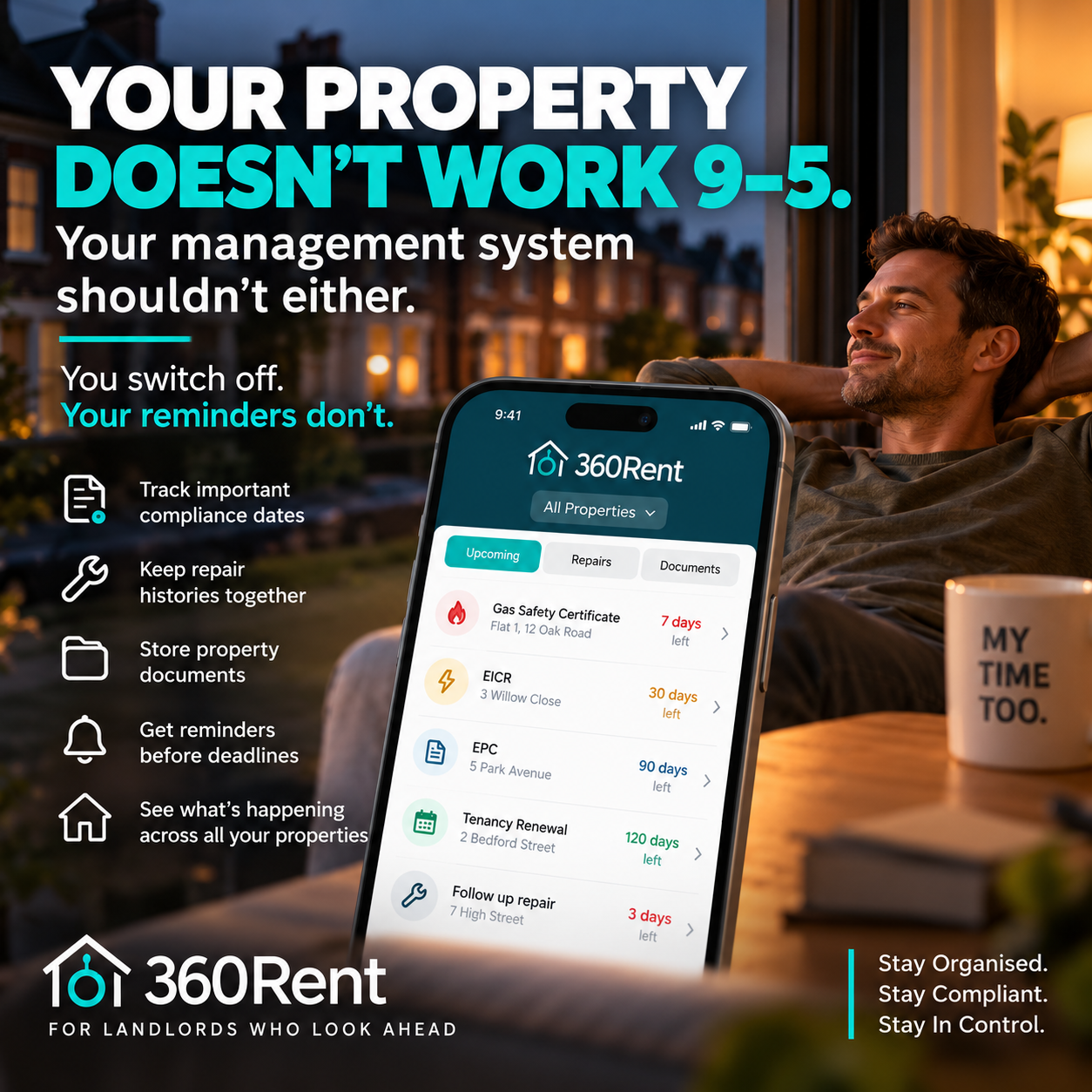
When we started thinking about reminders within 360Rent, the obvious use was compliance.
Record an important expiry date against a property and make it easier to see what's approaching.
But the bigger idea isn't really about notifications.
It's about creating a system around the landlord.
If a certificate expiry date is recorded, you shouldn't have to repeatedly check it yourself.
If you've recorded a repair, you should be able to return to that history later.
If you need a property document, you shouldn't have to remember whether it's in your emails, photographs or another folder.
The aim isn't to replace the landlord.
It's to remove some of the remembering from being one.
Imagine remembering three months before the deadline
There's a big difference between discovering something expires next week and knowing months beforehand.
That's why advance reminders matter.
For important compliance dates recorded in 360Rent, our approach is to help landlords see approaching deadlines ahead of time rather than waiting until the last minute.
That creates time.
Time to contact a contractor.
Time to arrange access.
Time to deal with availability.
Time to resolve a problem.
And importantly:
Time to remain in control.
A reminder doesn't complete the landlord's responsibility for them.
But it can help make sure that responsibility is visible before it becomes urgent.
AI is changing property too
The estate-agent research is interesting for another reason.
Technology companies are already developing AI voice systems capable of answering out-of-hours calls, gathering information, qualifying enquiries and even booking appointments.
Whether every agency needs that technology is another question.
But the direction is interesting.
Technology is increasingly being used not simply to make people work faster, but to handle routine tasks when people aren't working at all.
For landlords, that same principle can be applied more simply.
You don't necessarily need an AI answering your phone at midnight.
You might simply need your property information organised properly and your important dates working in the background.
Sometimes innovation isn't about adding something complicated.
It's about removing something you shouldn't have needed to do manually in the first place.
The 30-second landlord test
Try something.
Without opening a folder, searching your emails or checking a spreadsheet:
When does your next property compliance document expire?
If you own several properties, try answering it for every one.
Then ask:
What's the next repair that needs following up?
Where's the last contractor information?
Where are the relevant property documents?
If the answer is:
"Give me ten minutes and I'll find it..."
That's exactly the problem better property-management systems should solve.
Not because you're a bad landlord.
Because your brain shouldn't be your property-management software.
DIY shouldn't mean doing everything yourself
This is becoming one of the principles behind 360Rent.
We believe landlords should be able to manage their own properties.
You shouldn't automatically need to outsource management simply because administration has become complicated.
But DIY doesn't mean every task needs to be manual.
The landlord should remain responsible for the decisions.
Technology can help with the organisation around them.
You stay in control.
The system helps you see what needs your attention.
Your property doesn't switch off when you do
And neither should your system.
You should be able to enjoy your evening without mentally running through expiry dates.
Go on holiday without wondering whether you've forgotten something.
Concentrate on your job without trying to remember a property task from three months ago.
That's where good technology earns its place.
Not by replacing the landlord.
Not by adding more noise.
But by quietly helping the landlord stay ahead.
Because ultimately, good property management shouldn't require you to think about your properties every minute of every day.
It should give you the confidence not to.
Stay Organised.
Stay Compliant.
Stay In Control.
Related Articles
- Landlord Record Keeping: What Documents Must You Keep? (UK Guide 2026)
- How Empty Properties Cost Landlords Thousands
- How to Increase Rental Profit Without Raising Rent
- Do Landlords Really Need Letting Agents? (An Honest 2026 Guide)
- The Best Organisational Tools for UK Landlords in 2026: How to Save Time, Stay Compliant and Reduce Stress