
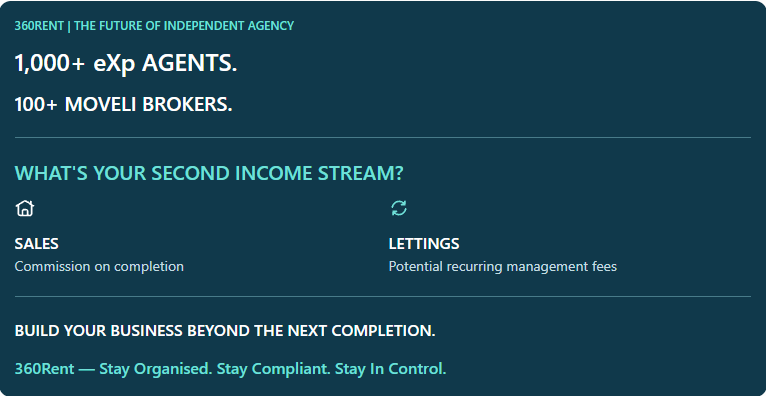
With eXp UK passing 1,000 agents and Moveli growing beyond 100 brokers, independent estate agencies are gaining momentum. But could a managed lettings portfolio help these entrepreneurs build more predictable monthly income?
The UK estate agency industry is changing.
For decades, the traditional career path was relatively straightforward.
Join an agency. Build experience. Progress to senior negotiator, manager or director. Perhaps eventually open your own branch.
But another model is gaining ground.
Experienced estate agents are increasingly choosing to work independently, supported by networks that provide technology, branding, training and business infrastructure.
And the growth figures are difficult to ignore.
In June 2026, eXp UK announced that it had passed the 1,000-agent milestone.
Moveli has now reported more than 100 self-employed brokers, having more than tripled its network in two years.
These are different businesses with different operating models, but both reflect an appetite for greater independence within estate agency.
Agents are increasingly choosing to build businesses for themselves.
But that raises an interesting question.
If you're building your own estate agency business, why rely entirely on sales commissions?
eXp UK: From 50 agents to more than 1,000
eXp UK launched in late 2019 with approximately 50 agents.
Its reported growth has been substantial.
The network reached 600 agents during 2024, passed 800 in 2025 and entered 2026 with approximately 900.
By June 2026, eXp announced that more than 1,000 agents had joined its UK network.
That's approximately twenty times its initial size.
The company has also developed its Teams model, designed to support established agency businesses moving towards a self-employed structure.
This growth suggests that the appeal of independence isn't limited to individual negotiators wanting to work alone.
It's increasingly attracting established professionals and businesses looking for alternative ways to operate.
The 1,000-plus milestone is based on eXp's reported agent sign-ups, rather than a live count of profiles displayed on its website.
Nevertheless, the longer-term growth is significant.
Moveli is seeing similar demand
Moveli provides another example.
Founded in 2018, the business focuses on experienced brokers operating in the higher-value residential market.
Its network has grown beyond 100 brokers, more than tripling over two years.
According to Moveli, its brokers have an average of approximately 20 years of property industry experience.
Many previously held senior positions within traditional agencies.
Moveli also reports almost £1 billion in property sales since launching, with an average sale price of approximately £1.2 million.
Like eXp, Moveli combines individual independence with centralised business support.
And it is investing in proprietary technology and AI to improve efficiency.
Both businesses illustrate a wider shift.
Experienced agents want greater control over their careers, income and businesses.
But independence creates new responsibilities.
And one of the biggest is cash flow.
The challenge with a sales-only business
Residential sales can generate excellent commission income.
But even the most experienced agent cannot control every stage of a transaction.
- Buyers withdraw.
- Mortgage offers are delayed.
- Surveys reveal problems.
- Chains collapse.
- Solicitors encounter complications.
- And a transaction agreed today may not complete for several months.
For a self-employed agent, that can create uneven income.
One month might produce several completions.
The following month might produce none.
Yet the costs of running the business continue.
- Marketing.
- Subscriptions.
- Transport.
- Insurance.
- Professional services.
- Living expenses.
That's why I think there's an opportunity worth exploring.
What if independent agents could build recurring monthly revenue alongside their sales pipeline?
Could lettings provide the second income stream?
Many self-employed agents already have relationships with landlords, investors and property owners.
Some of those clients may need help letting or managing their properties.
Others may be looking for a more personal service than a traditional agency can provide.
Rather than focusing exclusively on sales, an independent agent could potentially develop a small managed lettings portfolio.
The financial model is different.
Instead of receiving a commission only when a property sale completes, ongoing property management can generate recurring fees.
Consider an illustrative example.
Managed properties
- 5 at £1,000, charged 10% would = £500
- 10 at £1,000, charged 10% would = £1000
- 15 at £1,000, charged 10% would = £1,500
- 25 at £1,000, charged 10% would = £2,500
These examples assume every property is let, the rent is collected and the stated fee is earned. They exclude VAT, operating expenses, insurance, compliance costs and other business costs.
At fifteen properties, the illustrative gross annual management-fee income would be £18,000.
Not a guaranteed salary.
Not passive income.
But potentially a useful foundation alongside sales commissions.
And as an agent's business grows, that recurring revenue could help smooth some of the uncertainty associated with sales completions.
A landlord relationship can create opportunities beyond one transaction
An estate agent's local network is often one of their greatest assets.
Consider the relationships built through everyday agency work.
A homeowner deciding whether to sell or rent.
An investor purchasing their next buy-to-let.
A landlord considering selling part of their portfolio.
A buyer looking for an investment property.
A seller relocating but retaining their existing home.
These relationships don't necessarily end when a transaction completes.
A sales agent with the right expertise and business structure could potentially provide ongoing services.
And a lettings client may eventually become a sales client.
The opportunity isn't simply to manage more properties. It's to build longer-term client relationships.
But running lettings is a business, not a side hustle without responsibilities
This distinction matters.
Managing a property on behalf of somebody else involves more than collecting a monthly fee.
There are repairs to coordinate, tenants to communicate with, records to maintain and legal responsibilities to understand.
In England, agents carrying out relevant lettings or property-management work must belong to an approved redress scheme.
Agents holding client money must also meet applicable client money protection requirements.
Other legal, financial and operational obligations may apply depending on the services provided.
And self-employed agents operating under a network should check their contractual arrangements before introducing additional services.
Recurring revenue only creates a stronger business when the service behind it is sustainable and professional.
That brings us to technology.
Could technology make a small lettings portfolio more manageable?
Traditionally, setting up a lettings business could mean adopting substantial agency infrastructure.
- Complex software.
- Multiple systems.
- Office administration.
- Document storage.
- Repair tracking.
- Communication processes.
But independent agents may not need the same infrastructure as a large branch network.
An agent managing five or ten rental properties needs something practical.
- A clear record of each property.
- Important compliance dates.
- Tenancy information.
- Repair histories.
- Contractor details.
- Documents.
- Reminders.
And a way to see what needs attention.
The objective isn't to remove the agent from the process.
It's to reduce the amount of repetitive administration involved.
Technology should make an independent business easier to operate, not create another layer of work.
Could 360Rent support this next generation of agents?
360Rent was originally developed for independent landlords who want to manage their own properties professionally.
The platform focuses on organising the essential elements of rental property management.
- Properties.
- Tenancies.
- Compliance information.
- Documents.
- Repairs.
- Reminders.
But as self-employed estate agency grows, there's a potential opportunity to develop that foundation further.
Imagine a self-employed agent with an established sales business.
They have relationships with several local landlords.
They want to offer a professional management service without immediately adopting an expensive enterprise agency system.
Could a simpler, mobile-first platform help them get started?
Potentially.
But it would need to be developed around the specific requirements of agents managing properties for other people.
That could include landlord-client accounts, permissions, reporting, management-fee workflows and suitable integrations.
These are opportunities for future development, not features we are claiming 360Rent already provides.
What if independent agents helped build the solution?
This is the part I find most interesting.
eXp and Moveli have demonstrated the importance of giving independent agents access to technology and infrastructure.
But there's an opportunity to explore tools specifically for smaller lettings portfolios.
Rather than trying to build a complicated agency platform based on assumptions, why not involve the agents themselves?
- Ask what they need.
- Understand their existing systems.
- Find out which tasks consume the most time.
- Identify what would make managing five properties viable.
- Then ten.
- Then fifteen.
Build around real workflows rather than adding features simply because other software platforms have them.
That's a direction worth exploring for 360Rent.
A landlord-focused app today.
Potentially a more flexible property-management platform for independent landlords and smaller agency businesses in the future.
Developed with the people who would actually use it.
Independence should mean more than working for yourself
The growth of eXp UK and Moveli suggests experienced estate agents are increasingly willing to explore alternative business models.
And that's encouraging.
- More choice.
- More independence.
- More opportunity to build something personal.
- But being self-employed doesn't automatically create a resilient business.
- That requires planning.
- Reliable systems.
Strong relationships.
- And, where appropriate, diversified income.
- For some agents, lettings could be a valuable addition.
- For others, concentrating entirely on sales will remain the better strategy.
- There's no universal answer.
But it's a conversation worth having.
If you're building an independent estate agency business, perhaps the next question isn't just how many homes you can sell.
It's what kind of business you want to own five years from now.
At 360Rent, we're interested in hearing from self-employed agents who would consider building a managed lettings portfolio.
What would make it worthwhile?
What would make it difficult?
And what would you need from the technology supporting it?
Because the future of property management shouldn't simply be built for large agency groups.
It should also be accessible to the independent professionals building businesses of their own.
360Rent : Stay Organised. Stay Compliant. Stay In Control.
This article is for general business information. The fee examples are illustrative, not income forecasts. 360Rent's existing landlord-focused functionality should not be interpreted as a complete professional lettings agency management or client-accounting solution.
Related Articles
- Rental Yields Reach 7.9%... But Growing a Property Portfolio Creates a Different Challenge
- UK Property Transactions Are Falling… But What Are the Numbers Actually Telling Us?
- Are Letting Agents Becoming More Professional… And What Could That Mean for Landlords?
- Estate Agents Feel the Heat as the UK Property Market Cools... But the Work Doesn't Stop
- Why Are Estate and Letting Agencies Expanding While Others Are Leaving the Market?